
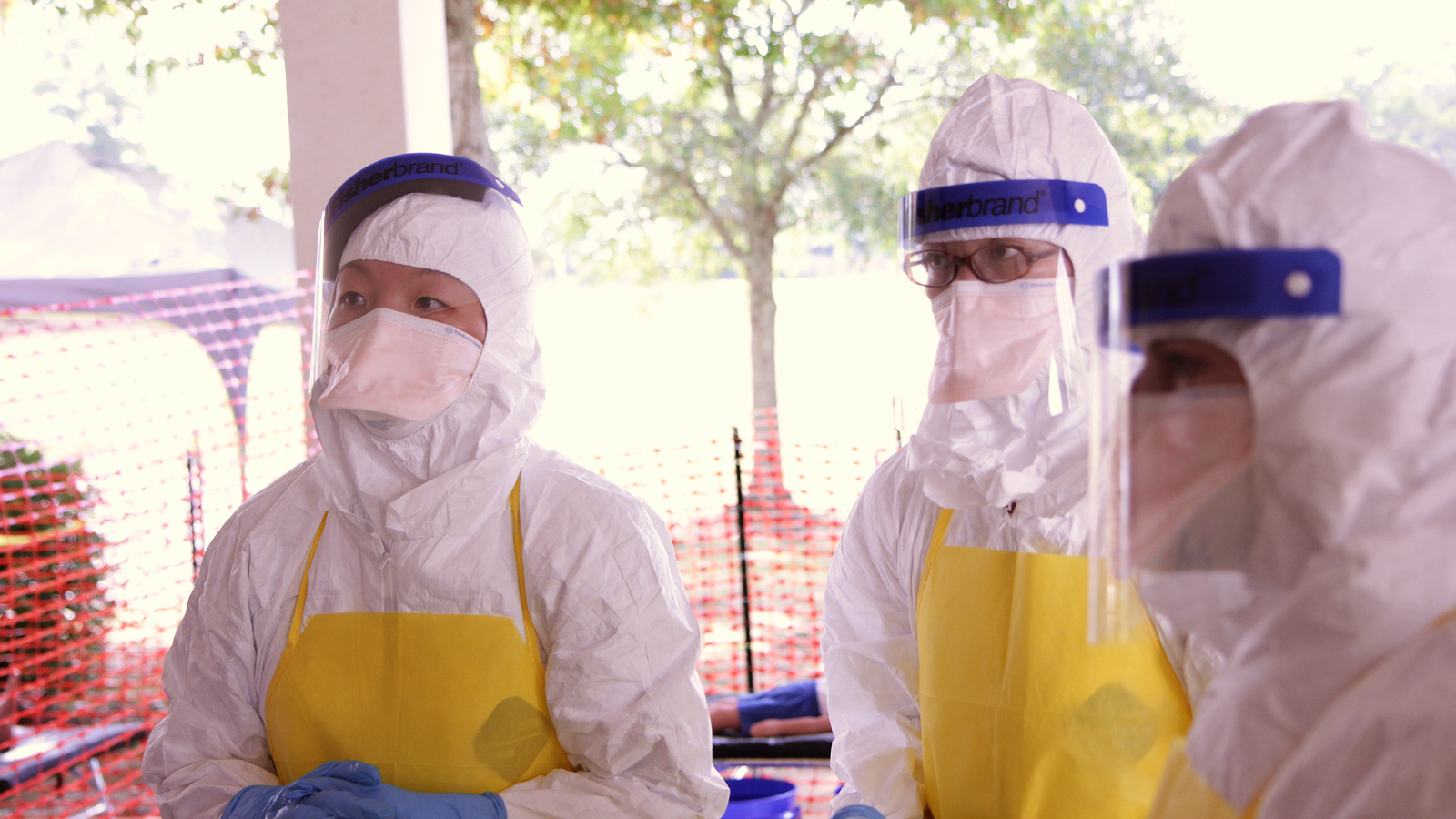
The United Nations has warned that the Ebola outbreak in the Democratic Republic of Congo (DRC) is ‘growing exponentially’.
The DRC is currently facing its most severe Ebola outbreak on record. More than 5 500 cases have been reported, as well as more than 2 500 deaths. The epidemic continues to spread.
The outbreak has already surpassed the death toll of the country’s 2018 to 2020 Ebola epidemic. Health authorities warn that transmission remains difficult to control.
The outbreak is being driven by the Bundibugyo species of Ebola, a relatively rare form of the virus for which there is currently no licensed vaccine or specific treatment. The combination of a highly mobile population, conflict, limited healthcare access, mistrust and delayed detection has created an unusually difficult diagnostic environment.
In light of this outbreak, researchers are looking to technology as a means to strengthen infectious disease medicine. Such technology includes portable imaging, biomarkers, Artificial Intelligence (AI) and remote monitoring. These could help clinicians identify deterioration earlier and intervene before patients become critically ill.
The World Health Organisation stresses that rapid laboratory confirmation is critical both for appropriate treatment and for preventing transmission.
Ebola is not simply a disease of fever and bleeding. Severe infection can produce profound fluid loss, electrolyte abnormalities, shock, hypoxia, haemorrhage and multi-organ failure. These complications can evolve rapidly.
However, for clinicians working in an Ebola treatment unit, assessing a critically ill patient can be challenging. This is because conventional imaging may require transporting a highly infectious patient to another part of a hospital, increasing logistical difficulties and potentially exposing additional staff or equipment.
A suggestion for intervention is portable ultrasound. Point-of-care ultrasound, or POCUS, can bring imaging directly to the bedside.
Ultrasound can potentially provide information about fluid status, the lungs, abdominal organs and other complications. In Ebola patients with severe diarrhoea, vascular leakage and multi-organ dysfunction, determining whether a patient is dangerously depleted of fluid or developing respiratory complications can be difficult clinically. Research involving handheld ultrasound during a Sudan virus outbreak in Uganda suggested that point-of-care ultrasound could assist with assessing fluid status and respiratory failure in resource-limited settings.
A small handheld ultrasound device could potentially travel with a medical team rather than requiring the patient to travel to the scanner.
However, portable imaging is not without its own problems. Any device entering an Ebola isolation area has to be carefully managed. Ultrasound probes, cables and other equipment can become contaminated, meaning cleaning and disinfection procedures are essential.
This is one reason why the future of infectious-disease imaging may depend as much on device design as on image quality.
A smaller, easier-to-disinfect probe could be more valuable during an outbreak than a technically superior system which is difficult to move or decontaminate. Wireless probes, protective covers and simplified bedside systems could potentially make imaging more practical in high-risk environments.
The goal would be to give frontline clinicians a small number of reliable imaging tools which answer immediate clinical questions.
AI could add another layer. AI-assisted ultrasound is already being investigated in other areas of medicine, including systems designed to guide image acquisition and help clinicians interpret findings.
In an Ebola treatment centre, an AI system might theoretically help a less experienced operator identify patterns suggesting pulmonary complications, fluid abnormalities or organ dysfunction.
However, this remains a future possibility rather than an established Ebola diagnostic application.
Training an algorithm to interpret Ebola-related imaging would require sufficiently large and representative datasets. That is difficult for a relatively rare disease, particularly one occurring predominantly in emergency settings where imaging resources may be limited.
There would also be a fundamental question of whether an algorithm trained on patients in one outbreak would perform reliably during another outbreak, in another country, with different equipment and patient populations.
The Remote Ebola Clinic
The geography of the current outbreak makes remote diagnostics particularly relevant. WHO describes the outbreak as occurring in a challenging environment characterised by humanitarian crisis, insecurity, population movement and densely populated or remote communities.
In such circumstances, bringing every patient to a specialist centre is unrealistic.
A future model could instead involve a network of small clinics equipped with rapid molecular tests, handheld ultrasound and digital communication. Images and clinical data could potentially be transmitted to specialists elsewhere, allowing radiologists, infectious-disease physicians or critical-care teams to provide remote support.
Ultimately, the goal would be earlier recognition.
The Evolution Of Ebola Treatment
Ebola treatment has evolved dramatically since the virus was first identified in 1976.
For decades, there were no approved therapies, and care focused largely on isolation, controlling symptoms and providing supportive treatment such as fluids and electrolyte replacement.
The devastating 2014 to 2016 West African outbreak accelerated research into targeted therapies, including monoclonal antibodies.
Clinical trials conducted during subsequent outbreaks demonstrated that treatments such as Inmazeb and Ebanga could significantly improve survival in patients with Ebola virus disease.
Today, these therapies are used alongside intensive supportive care, including management of dehydration, blood pressure, oxygen levels, pain and secondary infections. However, these approved treatments target the Zaire species of Ebola virus and do not currently cover other Ebola-causing viruses such as Bundibugyo, the strain responsible for the current 2026 outbreak in the Democratic Republic of Congo.
The current Ebola crisis is a reminder that diagnostic medicine does not operate in isolation from geography, infrastructure and public health. The most sophisticated scanner in the world is of little use if a patient cannot reach it safely. Conversely, a handheld ultrasound connected to a remote specialist could potentially become a powerful clinical tool in a setting where conventional radiology is impossible.