

Mental health has become one of the defining pressures on general practice. Anxiety and depression rarely arrive in neat diagnostic packages. They present as fatigue, insomnia, palpitations, unexplained aches, irritability, panic, alcohol overuse, workplace burnout, relationship strain, or a patient simply saying they “do not feel right”. For GPs, the task is not only to recognise psychological distress, but to decide how serious it is, what is driving it, which treatment route is appropriate, and when a patient may need urgent or specialist support.
That is the clinical backdrop to an upcoming educational event hosted by City Walk-in Clinic. Update in the Management of Anxiety and Depression with Dr Sophie Redlin. The session is designed for GPs, GP trainees and other healthcare professionals working in primary care, with a focus on practical, evidence-based decision-making rather than abstract theory.
The timing is significant. NICE guidance on depression in adults covers identification, treatment, relapse prevention, chronic depression and more complex cases, while its guidance on generalised anxiety disorder and panic disorder sets out structured approaches to care and treatment in adults. These frameworks are essential, but applying them inside a ten-minute consultation, particularly when risk, co-morbidity or social stress is present, remains one of the harder jobs in front-line medicine.
Part of the difficulty is that anxiety and depression are often intertwined with physical health. A patient with persistent tiredness may be depressed, anaemic, overworked, perimenopausal, grieving, lonely, sleep-deprived, hypothyroid, drinking too much, or some combination of the above. The best primary care consultation has to keep several possibilities open at once. It also has to avoid two opposite errors: medicalising every form of distress, or missing a serious mental health condition because it is hidden behind physical symptoms.
This is where continuing education for GPs becomes more than a professional formality. Updates in mental health management allow clinicians to revisit risk assessment, prescribing, psychological therapy pathways, treatment resistance and referral thresholds. They also create space to discuss what actually happens in everyday practice: the patient who does not want medication, the patient who wants medication too quickly, the patient who has tried two antidepressants without benefit, the patient whose symptoms are driven by work or trauma, and the patient whose suicide risk is difficult to gauge.
NHS Talking Therapies services provide psychological interventions for adults in England experiencing anxiety disorders and depression, including NICE-recommended treatments delivered in different formats, such as face-to-face, remote, individual and group settings. In practice, primary care clinicians often play a key role in explaining these options, setting expectations and helping patients understand why talking therapies may be offered alone or alongside medication.
The City Walk-in Clinic event will cover updated prescribing strategies, psychological treatment pathways, risk assessment, the management of treatment resistance, and when to refer for specialist support. It will also examine common clinical pitfalls, a particularly important area in mental health, where the consequences of under-treatment, over-treatment or delayed escalation can be substantial.
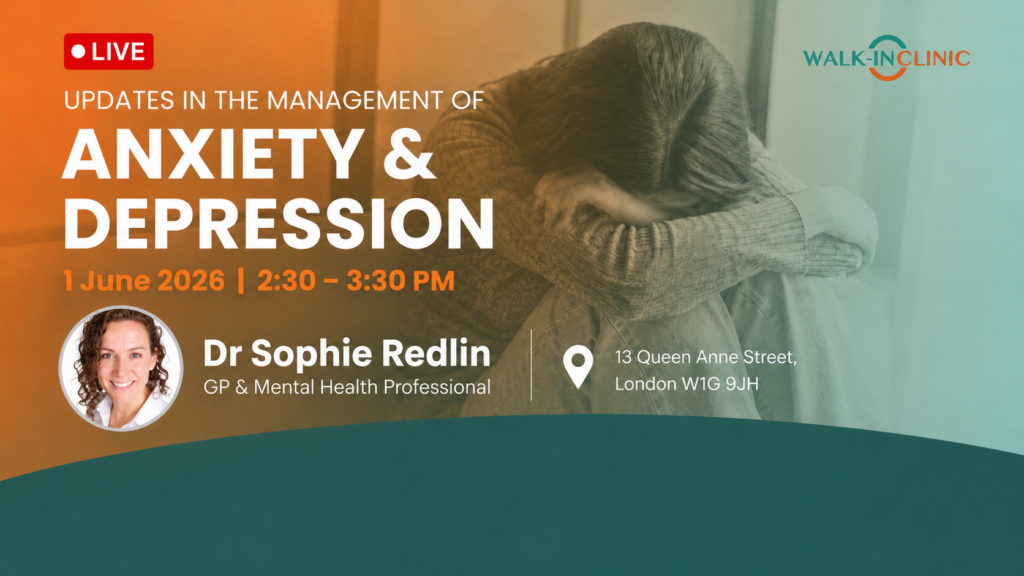
Dr Sophie Redlin brings a broad and relevant perspective to the subject. She is a GP, mental health researcher and trainer, expedition doctor and filmmaker, with work exploring emotional wellbeing, community support and mental health training in challenging environments. Her professional interests extend beyond conventional primary care into medical anthropology, remote medicine, moral injury and burnout, giving her a useful lens on how distress is shaped by culture, environment, work and community.
That breadth matters. In general practice, anxiety and depression are rarely only pharmacological problems. Medication can be important, sometimes essential, but the broader clinical picture often includes sleep, employment, relationships, isolation, trauma, housing, financial pressure, substance use, chronic illness and access to support. A useful GP update therefore has to deal not only with which medicine to prescribe, but how to think through the patient’s life as part of the clinical assessment.
The event is also expected to include time for questions, discussion and shared clinical experience. That may be one of its most valuable elements. Mental health consultations often involve judgement calls that cannot be reduced to a flowchart. Clinicians benefit from hearing how colleagues handle uncertainty, manage follow-up, document risk, communicate with families, and decide when a patient’s presentation has moved beyond what primary care can safely hold.
For patients, the importance of this work is obvious. The GP is often the first professional they speak to when their mental health begins to deteriorate. A well-conducted primary care consultation can validate distress, identify risk, open access to therapy, start appropriate treatment, rule out physical contributors and create a plan. A rushed or poorly structured one can leave a patient feeling dismissed, confused or unsafe.
The wider point is that anxiety and depression management is no longer a peripheral part of general practice. It is central to the work. As demand rises and presentations become more complex, clinicians need regular, practical updates that combine evidence, clinical judgement and humanity.